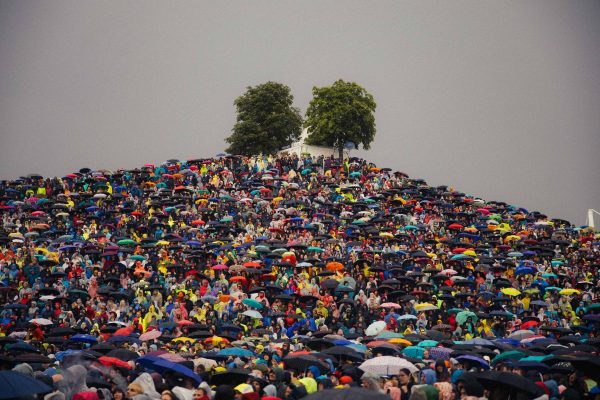
Large crowd of people gathered on a hill holding colorful umbrellas under a gray sky with two trees and a small structure at the top.

© Das Fest | Steffen Eirich

Weather Preparedness and Resilience Toolbox

Weather and climate define the environmental frame in which festivals take place – and both are changing in ways that directly influence the festival season.

Traditional expectations of “typical summer weather” are no longer reliable. Weeks of stable sunshine can be interrupted by sudden downpours; long dry periods can turn into heavy, concentrated rainfall within hours; and warm evenings may just as easily become nights of unexpected cold or high winds. These shifts do not only create inconvenience – they change the physical environment in which visitors move, rest, queue, camp and celebrate. This is the reason why we have created this Weather Toolbox.

A truly weather-ready festival means thinking of everyone – providing clear, accessible information, planning for comfort and safety, and creating conditions that make every person on site feel protected, included, and welcome, no matter what the sky brings.

The Weather Toolbox brings together practical and research-based resources to give background information on weather & climate to help you design safer and more weather-resilient festivals and outdoor events.

It is aimed at organizers, safety professionals, production teams – everyone involved in planning, building, and operating open-air events. And of course we do not forget about the audience. The PDF version of the Weather Toolbox summarizes the most important topics and includes links to this website, where you can find more detailed texts on everything mentioned in the PDF.

The Toolbox’s Structure

Extreme weather can affect events in many different ways often at the same time. To make it easier to find the right tools and information, this toolbox is divided into practical chapters that address specific aspects of weather preparedness and response.

The first chapter addresses weather & climate in general, whereas the following chapters cover different aspects of planning, risk assessment, communication and implementation on site.

Also, there’s a look into the media and some case studies to show that this is not about theory only but about real life.

Additional resources help to educate yourself and others even better.

We are using ISSUU to host and display interactive PDF files. To access the actual content, click the button below. Please note that doing so will share data with third-party providers.

More Information

Glossary

Weather preparedness and resilience toolbox title on a dark blue abstract background with logos and "Published in 2026" text.

Everyone knows what a “storm” is – but do we really? Do we really speak of the same phenomenom when we say, “there is a storm coming”? – Clear terminology does not only help to improve the understanding of the topic but also is – like clear thresholds – an important part of each risk assessment and each decision matrix.

Read more

01 Weather Hazard Awareness

Tools

Weather Toolbox – Global Annual to Decadal Climate Update

The report is an official WMO report that combines predictions from several designated global climate prediction centres to assess likely global temperature and related climate conditions for 2025–2029. It is part of WMO’s regular update…

Tools

Weather Toolbox – Responding to climate change impacts on human health in Europe

The report describes how changing precipitation patterns, more frequent and intense floods, droughts and deteriorating water quality affect human health in Europe (e.g. injuries, infectious diseases, chemical exposure, mental health). It assesses how well Europe…

Tools

Weather Toolbox – ESOTC 2024

The ESOTC 2024 is the authoritative annual assessment of observed climate conditions. It provides descriptions and analyses of climate conditions in Europe in 2024, covering variables from across the Earth system, key events and their…

Tools

Weather Toolbox – State of the Climate Update for COP30

World Meteorological Organization “State of the Climate Update for COP30 (wmo)​This is an official WMO update summarizing key climate indicators and recent trends, positioned as a reference document for COP30 decision-makers. ​

Tools

Weather Toolbox – WEATHER HAZARD AWARENESS

Weather hazard awareness is a foundational competence for anyone responsible for the planning, approval, and operation of outdoor festivals. Unlike many other risks, weather hazards are not hypothetical, adversarial, or exceptional – they are guaranteed…

Tools

Weather Toolbox – Weather Hazard Awareness – Temperature

Weather hazard awareness for temperature-related phenomena starts with understanding how heat and cold episodes form, how they impact people and infrastructure, and why they are changing in Europe. For crowd and event managers, these processes…

Tools

Weather Toolbox – Weather Hazard Awareness – Precipitation

Weather hazard awareness for precipitation-related phenomena means understanding how different types of rain, snow and ice form, how quickly they can intensify, and what they do to people, infrastructure and event operations. For crowd and…

Tools

Weather Toolbox – Weather Hazard Awareness – Wind

Wind-related weather phenomena create some of the fastest‑developing, hardest‑to-control hazards for crowds and temporary event infrastructure, especially in Europe’s increasingly volatile convective storm environment.

Tools

Weather Toolbox – Weather Hazard Awareness – Soil and Surface

Weather-related soil, surface and water processes can rapidly turn an otherwise safe event site into a high-risk environment for crowds, infrastructure and operations. Understanding how ground saturation, mud, flash flooding and river flooding behave is…

Tools

Weather Toolbox – Weather Hazard Awareness – UV and Radiation

Weather hazard awareness for solar radiation starts with understanding how UV intensity, heat and glare interact with crowds, infrastructure and operations at outdoor events. For crowd managers, the UV Index is a practical trigger for…

Tools

Weather Toolbox – Weather Hazard Awareness – Special Aspects

Weather hazard awareness for events must go beyond “rain or shine” thinking and focus on how multiple, interacting weather and environmental factors affect crowd safety, infrastructure, and decision‑making. Special weather issues such as compound storms,…

02 Risk Assessment & Planning

Tools

Weather Toolbox – Introduction Risk Assessment

Weather-related risk assessment and planning are central to the safe operation of outdoor festivals. Unlike permanent venues, festivals are temporary, spatially dynamic systems characterised by limited structural redundancy, high crowd densities, compressed timelines, and significant…

Tools

Weather Toolbox – Weather-related Risk Assessments and Cascading Effects

Cascading effects turn a “simple” weather problem into a complex systems crisis, where one impact triggers another and overall risk grows non‑linearly. For weather risk assessment in events and crowd management, treating hazards as isolated…

Tools

Weather Toolbox – Risk Assessment Template Thunderstorm

Risk assessments for events must always be individual, site-specific, and phase-specific. Weather hazards such as thunderstorms do not pose a generic risk; their actual impact depends on local topography, site layout, structures, audience composition, operational…

Tools

Weather Toolbox – Risk Assessment Template Heavy Rain

Risk assessments for events must always be individual, site-specific, and phase-specific. Weather hazards such as thunderstorms do not pose a generic risk; their actual impact depends on local topography, site layout, structures, audience composition, operational…

Tools

Weather Toolbox – Risk Assessment Template High Winds

Risk assessments must always be individual, site-specific, and phase-specific. High winds do not create the same risk everywhere: exposure depends on local topography (wind channels, ridgelines, open fields), the density and type of temporary structures,…

Tools

Weather Toolbox – Risk Assessment Template Heat

Risk assessments must always be individual, site-specific, and phase-specific. Heat risk depends on microclimate (sun exposure, shade, wind), ground and surface materials, availability of water and cooling, crowd density and behaviour, audience vulnerability, staffing levels,…

Tools

Weather Toolbox – Risk Assessment Template Cold and Snow

Risk assessments must always be individual, site-specific, and phase-specific. Cold and snow risks vary significantly with local microclimate (wind exposure, elevation), ground and surface types, infrastructure (heating, shelter, power resilience), audience profile, and the operational…

Tools

Weather Toolbox – Risk Assessment Template Fog and Low Visibility

Risk assessments must always be individual, site-specific, and phase-specific. Fog and low visibility are highly dependent on local microclimate (topography, proximity to water, vegetation), lighting design, surface contrast, traffic interfaces, and operational phase. The same…

03 Monitoring & Early Warning

Tools

Weather Toolbox – Introduction Monitoring & Early Warning

For outdoor festivals, monitoring and early warning are the mechanisms that transform hazardous weather from an uncontrolled external threat into a manageable operational challenge. While risk assessments and contingency plans define what could happen, monitoring…

Tools

Weather Toolbox – Weather Monitoring and Early Warning Systems for Outdoor Events

Thunderstorms, flash floods, strong winds, extreme temperatures, and high UV exposure can rapidly transform stable situations into acute emergencies, with the difference in outcomes often coming down to proactive weather monitoring and having reliable alert…

Tools

Weather Toolbox – The Early Warning System (WHO)

The WMO defines an Early Warning System (EWS) as an integrated framework that anticipates and communicates weather-, climate- and water-related hazards in time for people and organisations to take action.

Tools

Weather Toolbox – Combined Weather Hazard Dashboard

A combined weather hazard dashboard is an integrated, decision-support interface that aggregates, contextualizes, and visualizes multiple weather-related hazards within a single, coherent operational view. Its primary function is not merely to display meteorological data, but…

Tools

Weather Toolbox – Severe Weather Information Centre

The homepage severeweather.wmo.int hosts the Severe Weather Information Centre (SWIC) 3.0, a platform operated under the World Meteorological Organization (WMO). WMO is the United Nations’ specialized agency for meteorology, climate, and hydrology that coordinates global…

Tools

Weather Toolbox – Forecasting vs Nowcasting

Many weather-related incidents at events occur not because the forecast was wrong, but because nowcasting information was missing, misunderstood, or not acted upon in time.

Tools

Weather Toolbox – Gathering Information on site

Effective weather risk management at events does not end with forecasts and warnings issued days or hours in advance. Once an event is underway, on-site information gathering becomes a decisive factor for situational awareness, operational…

Tools

Weather Toolbox – Some last advise

Do not work with multiple meteorological services in parallel for operational decision-making. Select one primary service whose data and interpretation form the basis for decisions.

04 Decision Making & Communication

Tools

Weather Toolbox – Introduction Decision Making & Communication

Decision making and communication are the decisive control layers of weather-related risk management at outdoor festivals. While hazard awareness, monitoring, and planning define what could happen, decision making and communication determine what actually happens in…

Tools

Weather Toolbox – Thunderstorm

This text is part of the Weather Preparedness & Resilience Toolbox developed by the YOUROPE Event Safety (YES) Group within YOUROPE’s 3F project (Future-Fit Festivals). It is aimed at everyone involved in planning, building, and operating open-air…

Tools

Weather Toolbox – Wind

This text is part of the Weather Preparedness & Resilience Toolbox developed by the YOUROPE Event Safety (YES) Group within YOUROPE’s 3F project (Future-Fit Festivals). It is aimed at everyone involved in planning, building, and operating open-air…

Tools

Weather Toolbox – Rain and Flood

This text is part of the Weather Preparedness & Resilience Toolbox developed by the YOUROPE Event Safety (YES) Group within YOUROPE’s 3F project (Future-Fit Festivals). It is aimed at everyone involved in planning, building, and operating open-air…

Tools

Weather Toolbox – Heat

This text is part of the Weather Preparedness & Resilience Toolbox developed by the YOUROPE Event Safety (YES) Group within YOUROPE’s 3F project (Future-Fit Festivals). It is aimed at everyone involved in planning, building, and operating open-air…

Tools

Weather Toolbox – Weather Decision-Making and Communication

This text is part of the Weather Preparedness & Resilience Toolbox developed by the YOUROPE Event Safety (YES) Group within YOUROPE’s 3F project (Future-Fit Festivals). It is aimed at everyone involved in planning, building, and operating open-air…

Tools

Weather Toolbox – Screen & PA Examples

Make sure that you have pre-approved micro-texts for public address systems (PA), screens / LED walls, and digital push channels (event apps, SMS, messenger services) for use in:

Tools

Weather Toolbox – Communication Phase Matrix

A Communication Phase Matrix (Phase × Channel × Message) is a structured communication planning instrument used to design, preload, and control the operational communication rhythm of an event day.

Tools

Weather Toolbox – Communication Principles

“You can not not communicate” – everyone knows this simple saying – but you can make a lot of mistakes when communicating – especially when stress, lack of time and excitement come into play.

Tools

Weather Toolbox – Audience Strategies

The same situation must be communicated differently to different audiences – without changing the underlying reality.

Tools

Weather Toolbox – Thirty Seconds

The First 30 Seconds Kit defines pre-approved, channel-specific message templates to be deployed immediately when an incident occurs during live operations. Its objective is to stabilize behavior, reduce uncertainty, and buy time for assessment and…

Tools

Weather Toolbox – Multi Language Approach

Nowadays it is no longer a problem to create multilingual messages – and still sometimes you wonder why there are only information available in the  national language.

Tools

Weather Toolbox – Artist Liaison

This document defines roles, authority, communication logic, timing windows, and safety clearance gates for coordinating weather-related show interruptions with artists and their representatives.

Tools

Weather Toolbox – Authority Notification

Formal notification to authorities following a Show Stop, Pause, or Partial Evacuation, ensuring transparency of risk assessment, decision authority, implemented measures, and review logic.

Tools

Weather Toolbox – Contractor Checklist Wind

This document provides a draft of a trade-specific, confirmation-based control framework for managing wind- and rain-related risks to temporary event infrastructure. It has to be adapted to individual event settings.

05 On-Site Implementation

Tools

Weather Tool Box – Introduction On Site Implementation

On-site implementation is the point where all planning, forecasts, and written procedures must translate into concrete behaviour, physical movement, and timely decisions on the festival site under real weather conditions.

Tools

Weather Tool Box – Measure Matrix

A measure matrix translates abstract risk assessments and contingency plans into clear, actionable on-site guidance.

Tools

Weather Tool Box – The Use of Role Cards and Action Cards

Role and Action Cards are the crip sheets among all tools. It‘s just good to have them . Role cards and action cards help to deliver concrete information with limited resources. They come in all…

Tools

Weather Tool Box – Action card checklist weather

The following checklist serves not only as an aid for processing measures, but also as a supplement to the event log within the framework of processing and should be signed by all participants at the…

Tools

Weather Tool Box – Do the Maths

Weather hazards and crowd dynamics are domains where assumptions fail quickly and consequences escalate fast. Intuitive judgments such as “people will move faster,” “the storm is still far away,” or “the exits should be sufficient”…

Tools

Weather Tool Box – Best practice from Festivals

Extreme weather phenomena (“severe weather”) may lead to the cancellation/termination or interruption of the event.

06 Training & Learning

Tools

Weather Tool Box – Introduction Training and Education

Training and learning for weather- and crowd-related safety are mandatory requirements in outdoor festival contexts. In temporary, high-density environments that rely on rapidly assembled, often changing teams, structured competence building is an important mechanism that…

Tools

Weather Tool Box – Yes Group Design Thinking

This text is part of the Weather Preparedness & Resilience Toolbox developed by the YOUROPE Event Safety (YES) Group within YOUROPE’s 3F project (Future-Fit Festivals). It is aimed at everyone involved in planning, building, and operating open-air…

Tools

Weather Tool Box – Table-Top Exercises

Tabletop exercises are one of the most effective ways for festival organisers to build realistic, weather‑related preparedness without putting visitors at risk, especially as extreme heat, storms and sudden downpours become more common at outdoor…

Tools

Weather Tool Box – Weather Related Tabletop Scenario 1

A tabletop for simultaneous heat and lightning should simulate a full festival day where extreme heat slowly escalates and a thunderstorm then forces rapid sheltering decisions.

Tools

Weather Tool Box – Weather Related Tabletop Scenario 2

Tabletop Exercise: Storm that causes serious infrastructure damage

07 Educating The Audience

Tools

Weather Tool Box -Educating the audience – Introduction

Educating the audience about weather risks and protective actions is a core control measure for outdoor festivals, not an add‑on to “customer information”.

Tools

Weather Tool Box – Audience Education Ideas

Design Principles:Short, memorable public guidance (“micro-messages”) is the core tactical unit of audience education.

Case Studies & Best Practices

Tools

Weather Tool Box – Flooding

This text is part of the Weather Preparedness & Resilience Toolbox developed by the YOUROPE Event Safety (YES) Group within YOUROPE’s 3F project (Future-Fit Festivals). It is aimed at everyone involved in planning, building, and operating open-air…

Tools

Weather Tool Box – High Winds & Gusts

Strong gusts hit the festival and parts of a main stage collapsed; one person was killed and dozens injured. Several temporary structures were damaged.

Tools

Weather Tool Box – Thunderstorms

A severe, fast-moving thunderstorm struck while the festival was underway. Multiple stages and tents were hit by violent winds, causing stage collapse and structural failures. Several people died and many were injured.

Tools

Weather Tool Box – Introduction Case studies

Case studies are one of the most powerful learning tools in the field of event and crowd safety, especially when they analyse weather‑related disasters in depth. They translate abstract principles into concrete practice, reveal the…

Tools

Weather Tool Box – Heat & Heatwaves

Recent European heatwaves have caused large increases in heat-related illness and deaths (studies and briefs show thousands to tens of thousands of excess deaths in summers such as 2003, 2019 and more recent events). These…

Further Resources

Mapping the impact of extreme weather on global events and mass gatherings: Trends and adaptive strategies:

https://www.sciencedirect.com/science/article/pii/S2212420925004522?via%3Dihub

Early Warnings for All in Focus: Hazard Monitoring and Forecasting:

https://wmo.int/publication-series/early-warnings-all-focus-hazard-monitoring-and-forecasting

ANSI ES1.7-2021 Event Safety Requirements – Weather Preparedness:

https://webstore.ansi.org/standards/esta/ansies12021

What if it rains? What if there are bushfires?’: extreme weather, climate change and music festivals in Australia:

https://journals.sagepub.com/doi/10.1177/1329878X231184913

Heat and mass gatherings: What is needed?:

https://www.sciencedirect.com/science/article/pii/S3050456224000063

Weather and Climate Risk Communication:

https://extranet.puq.ca/media/produits/documents/3358_9782760547575.pdf