This text is part of the Weather Preparedness & Resilience Toolbox developed by the YOUROPE Event Safety (YES) Group within YOUROPE’s 3F project (Future-Fit Festivals). It is aimed at everyone involved in planning, building, and operating open-air events. It helps festivals and other outdoor events become truly weather-ready by offering both practical and research-based resources as well as background information on weather and climate. Learn how to design safer and more weather-resilient outdoor events.
Creation of a Measure Matrix
A measure matrix translates abstract risk assessments and contingency plans into clear, actionable on-site guidance.
In live operations, decisions must be taken under time pressure, with incomplete information, and often by rotating staff. The matrix provides a pre-agreed decision framework that reduces ambiguity and prevents ad-hoc or inconsistent responses.
By linking observable triggers to defined measures, responsibilities, and communication steps, a measure matrix supports rapid, proportionate action without the need for lengthy discussions.
For on-site use, the key value lies in standardisation and transparency:
- all stakeholders share the same understanding of when and how to act,
- responsibilities are clearly assigned,
- and communication shifts in a controlled manner from information to instruction.
As a result, the measure matrix becomes a practical control-room tool: it supports situational awareness, improves coordination between safety, technical, and communication functions, and provides a defensible record of structured decision-making during dynamic event situations.
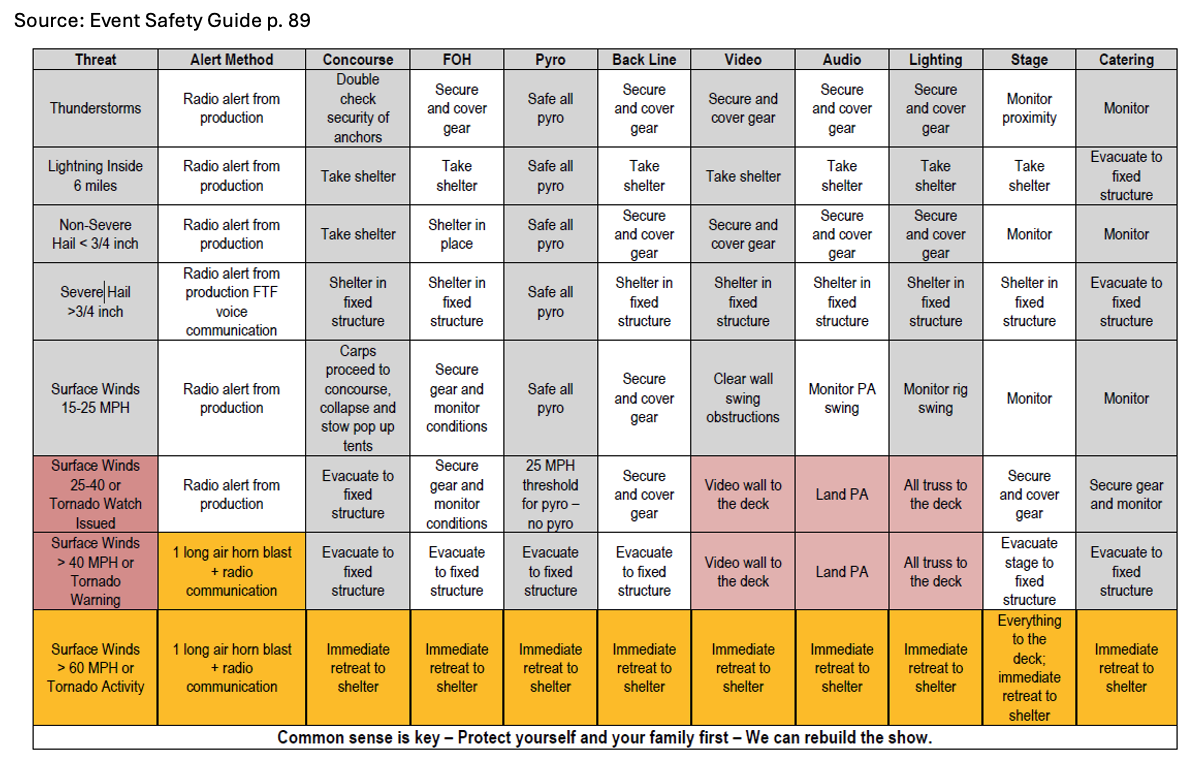
The Event Safety Guide already shows a nice structure for a measure matrix (p. 89), which we have adapted for our Tool-Box.
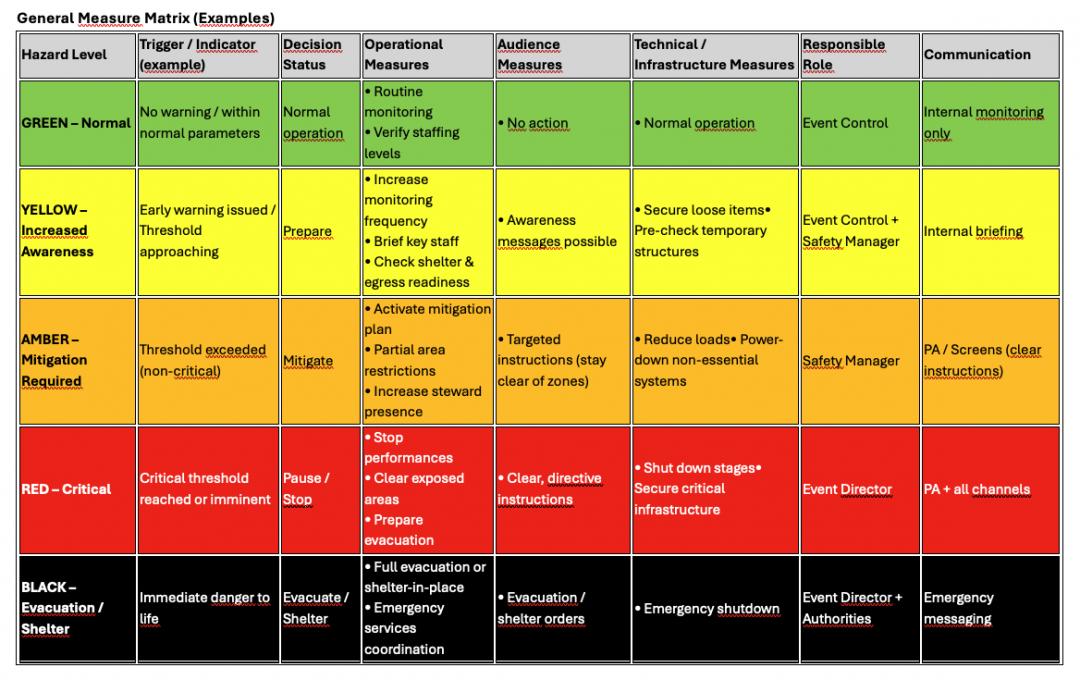
It is up to you if you use a “weather-phenomen” based matrix (one table for each weather phenomena as you can see in the example from the Event Safety Guide) or a matrix which generally follows an escalation logic (monitor → prepare → mitigate → pause/stop → evacuate) and separates decision, operational measures, and communication (as you can see below).
The important thing is: Create a matrix that fits to your needs
You can use your matrix as
- control room reference
- annex to the Show-Stop / Weather SOP
- tabletop exercise (TTX) worksheet
A more general escalation based approach
Structure
- Rows = Hazard escalation levels
- Columns = Decision, Measures, Responsibilities, Communication
Editable Fields
Replace or adapt the following according to the specifications of your site:
- Trigger / Indicator (e.g. wind gusts ≥ X km/h, lightning < Y km, rainfall ≥ Z mm/h)
- Operational Measures (e.g. monitoring, briefing, infrastructural measures)
- Audience Measures (e.g. PA wording, screen icons, app push)
- Technical Infrastructural Measures (e.g. bringing down light structures, secure loose items
- Responsible Role (e.g. Event Director, Safety Officer, Weather Officer, Technical Director)
- Communication Channels (e.g. PA, LED walls, app, stewards, radio)
Good Practice
- Decisions are condition-based, not forecast-based (actually, this depends upon your policy. There are events who work solely forecast-based which makes decisions much easier but which obviously does not allow any changes due to the actual situation – or rather: having a forecast-based policy and then changing your decision to condition-based will obviously start A HUGE discussion. This has to be documented in detail and with timestamps.
- Escalation must be documented and logged
- Communication shifts from informative → directive with each level