This text is part of the Weather Preparedness & Resilience Toolbox developed by the YOUROPE Event Safety (YES) Group within YOUROPE’s 3F project (Future-Fit Festivals). It is aimed at everyone involved in planning, building, and operating open-air events. It helps festivals and other outdoor events become truly weather-ready by offering both practical and research-based resources as well as background information on weather and climate. Learn how to design safer and more weather-resilient outdoor events.
The importance of tabletop exercises (TTX)
Tabletop exercises are one of the most effective ways for festival organisers to build realistic, weather‑related preparedness without putting visitors at risk, especially as extreme heat, storms and sudden downpours become more common at outdoor events. Used well, they turn written weather plans into practical decision‑making routines across production, safety, security, and external partners.
Tabletop exercises are structured, discussion‑based simulations in which key stakeholders walk through a hypothetical incident step by step, exploring decisions, information flows, and consequences rather than physically deploying resources. Participants typically sit together (on‑site or online) while a moderator presents evolving injects about the scenario and prompts the team to describe what they would do, why, and who they would involve.
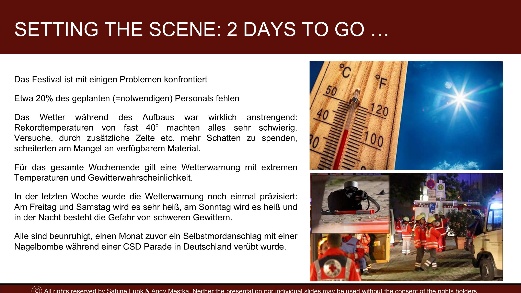
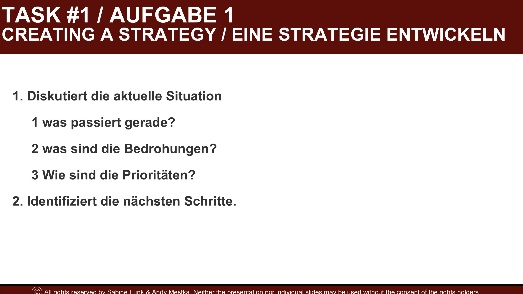
Photo: Yes Group
For weather at festivals, tabletop exercises focus on coordination and judgement: when to pause a show, when to shelter, and when to evacuate, rather than on tactical skills like first aid. This makes them particularly suitable for cross‑functional groups including festival direction, crowd management, technical production, medical, local authorities, and meteorological support.
They also expose interdependencies that are easy to miss on paper, such as how a phased evacuation for an approaching storm interacts with transport capacity, site bottlenecks, and vulnerable groups. Rehearsing these decisions in a low‑stress environment builds shared mental models so that, during a real storm cell or heat spike, the command team can act quickly and consistently rather than debating fundamentals.
Festival tabletop exercises commonly focus on a small number of credible but stressful scenarios that reflect the site layout, season and region, for example
- Sudden thunderstorm with lightning: Exercise injects may escalate from a watch to nearby lightning strikes within 15–30 minutes, requiring rapid stage clearance and possible temporary shelter‑in‑place instead of full evacuation.
- High winds and structural risk: Participants discuss when to take down banners, suspend use of certain stages, close big tops, or cordon off areas as gusts exceed agreed thresholds.
- Flash flooding or heavy rain: The scenario can involve rising water affecting access roads and low‑lying camping, forcing decisions on rerouting flows and prioritising evacuations from specific zones.
Using site‑specific data such as crowd numbers, exit capacities and maximum acceptable evacuation times (e.g. targets of 10–20 minutes for high wind or 5 minutes to clear stages when lightning is imminent) makes these scenarios more concrete and exposes unrealistic assumptions.
Designing and running effective table-top sessions
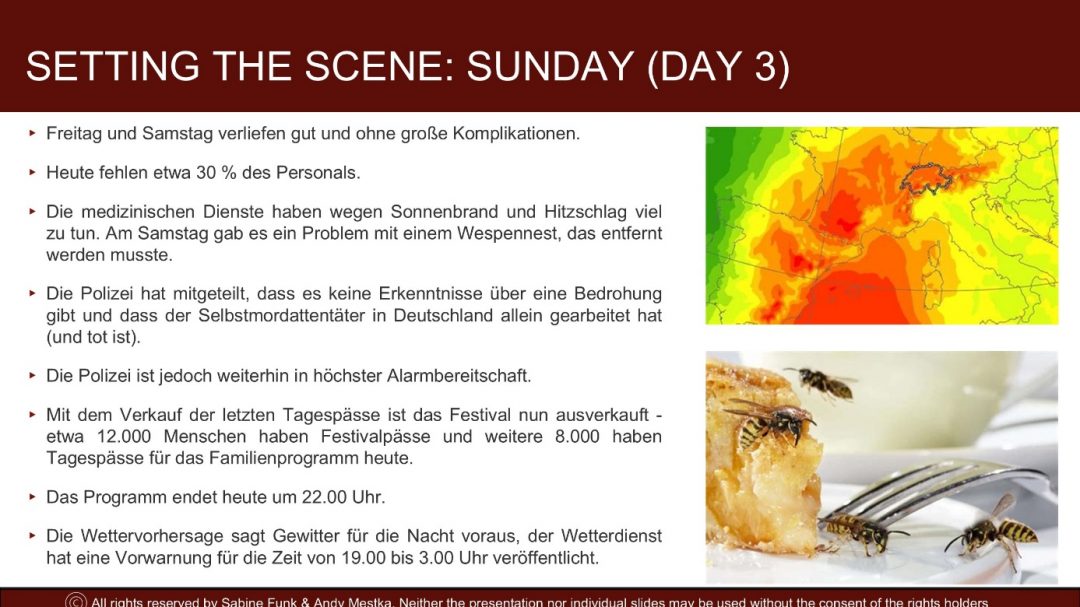
In a tabletop, participants do not “act out” responses; they talk through them while a facilitator reveals how the scenario evolves. A scenario and a series of update statements (injects) are read aloud or displayed, and each update prompts a new round of decisions and discussion.
The aim is to surface how people understand plans, thresholds and responsibilities under pressure, not to score them on right or wrong answers. The exercise is explicitly “no‑fault”: mistakes are treated as findings for improvement, which encourages honest participation.
Roles in a tabletop
Most guidance recommends four main role types in a TTX.
- Players: Active decision‑makers who speak “in role” (festival director, safety officer, weather liaison, crowd manager, medical lead, etc.) and describe what they would do, who they would inform, and which tools or plans they would use.
- Facilitator: Designs the scenario, sets the rules, presents injects, keeps time, and uses questions to draw out quieter participants and keep discussion on objectives.
- Evaluators/recorders: Take structured notes on decisions, timelines, issues and good practices for the after‑action review, without driving the scenario.
- Observers: Sit in mainly to listen and learn; they may offer occasional perspectives but do not steer decisions.
For a festival weather TTX, players should reflect the incident command structure used on show days: command, operations, safety, technical production, crowd services, campsite, communications, and liaison roles for police, fire, ambulance or city authorities where feasible.nexightgroup+1
How to prepare and facilitate a tabletop
Preparation (before the day)
- Define 2–4 specific objectives (e.g. “test lightning trigger points and evacuation messaging for the main stage”).
- Select participants and confirm roles, book a quiet room, prepare maps, timelines, weather charts, and print the scenario brief and injects.
- Send a short pre‑read with objectives, ground rules and any plan excerpts you want people to know.
Opening and ground rules
- The facilitator welcomes participants, reviews objectives, explains the “no‑fault” principle and basic rules (stay in role, talk through actions, respect time limits).
- Quick introductions help everyone understand who holds which responsibilities in real operations.
Initial scenario brief
- The facilitator reads a concise starting situation: e.g. “It is 17:00 on the second festival day; 35,000 visitors are on site; radar shows a thunderstorm line 40 km west with forecast gusts up to 25 m/s in 45–60 minutes.”
- Maps or site diagrams are displayed so players can point to stages, campsites, access roads and shelters when discussing options.
Discussion rounds with injects
- Each round starts with an inject (new information) and a time jump, such as “T+15 minutes: wind picks up, MET warning upgraded, queues at entrance still 2,000 people.”
- The facilitator then asks pointed questions: “What do you do in the next 10 minutes? What messages go to artists, security, visitors? Who authorises a show stop?”
- Players describe their decisions and information flows; the facilitator may challenge them with realistic constraints (limited staff, conflicting information, simultaneous incidents) while keeping the scenario plausible.anm+1
- Not all injects escalate; some show improvement (storm weakening, new shelter capacity) to test whether teams can also de‑escalate and return to normal operations.
Wrap‑up and debrief
- The exercise usually ends after a predefined “end state” (e.g. post‑storm recovery, partial evacuation, or heatwave peak).
- The facilitator leads a structured hot‑wash: What worked well? What confused you? Which SOPs, tools, or agreements need updating? Evaluators share key observations.
- Findings are captured in an after‑action report with clear improvement actions, owners, and deadlines so the TTX leads to concrete changes.
Injects
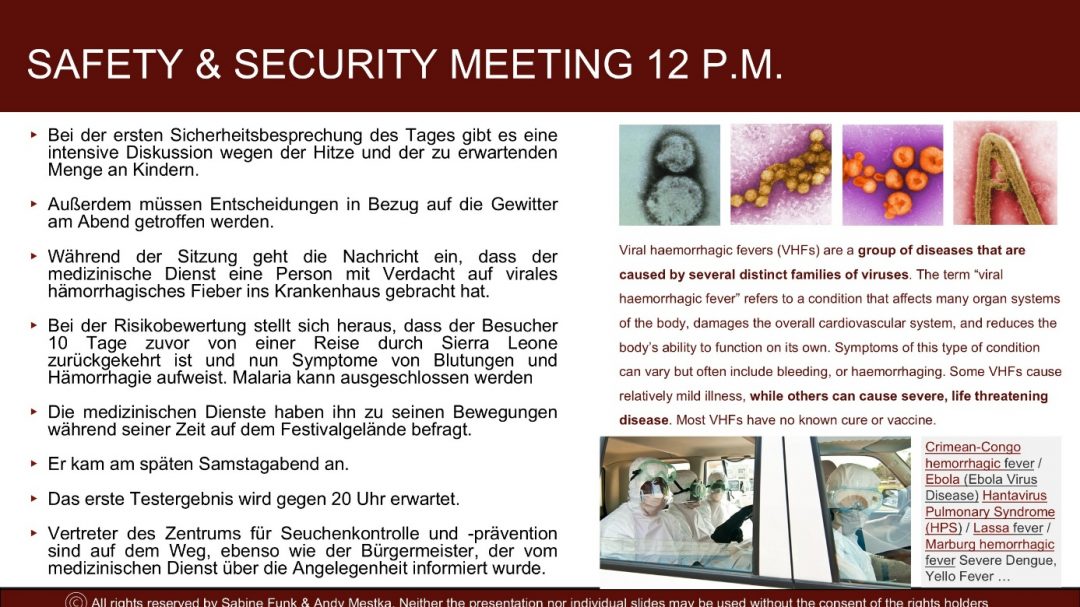
Injects are the engine of a TTX, introducing new developments that force participants to adapt. For weather‑focused festival exercises, effective injects share several characteristics.
- Realistic timing and detail: Weather updates should match typical lead times (e.g. watches hours in advance, warnings 30–60 minutes out, very short notice for lightning) and include operationally relevant data like gust speeds, rainfall rates, and temperature trends.
- Operational consequences: Injects should describe what weather does to the site and crowd, not just numbers, e.g. “Water pooling near Gate C, one shuttle route blocked, two food vendors report tent damage.”
- Decision pressure: Each inject should naturally lead to dilemmas: evacuate now or wait, evacuate partially or fully, pause ingress, or move people to shelters, etc.
- Variation: Some injects add problems (power loss, communication failure), others add resources (extra buses, additional shelter space) so teams practise reallocating effort.
A typical weather TTX might have 6–12 injects over 60–90 minutes, each advancing the clock and pushing decisions closer to key thresholds like stage stops, shelter‑in‑place, or site evacuation.
Photo: IBIT GmbH / Anke Hesse
Practical tips to make TTMs work at festivals
- Keep the environment comfortable: Good room layout (everyone can see each other and maps), refreshments, and clear visuals support participation and reduce defensiveness.
- Anchor to real plans: Have the festival emergency operations plan, weather SOPs and communication templates on the table, and encourage players to use them as they would on show day.
- Focus on decisions, not storytelling: If discussion drifts into debating the scenario realism, the facilitator should gently bring it back to “Given this situation, what would you do?”.
- Timebox rounds: Short, focused discussion (e.g. 10–15 minutes per inject) keeps energy high and ensures the group reaches the most critical decision points.
- Capture specifics: Record exact messages, timings, and who does what; vague notes (“improve communication”) are much less useful than concrete ones (“create a pre‑approved SMS for lightning‑driven show stop”).
Used this way, tabletop exercises become a repeatable, low‑cost method for festivals to rehearse complex weather decisions, align partners, and turn static plans into shared, practised behaviour.
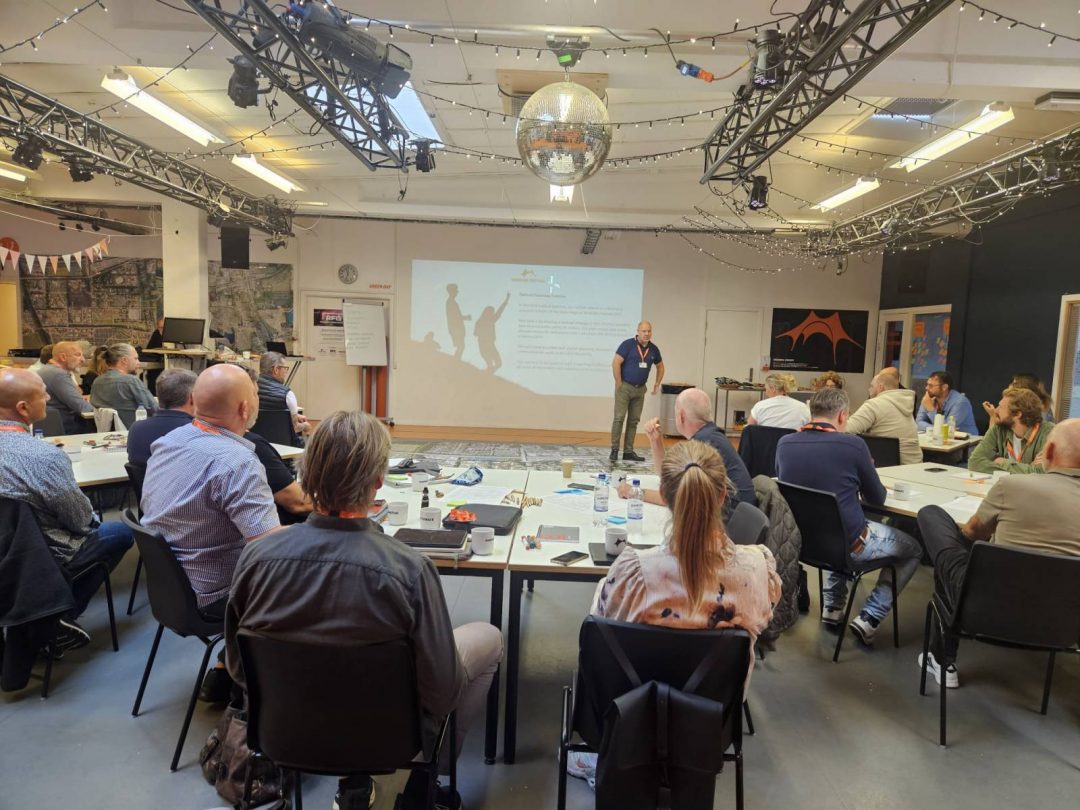
Photo: YES Group
Practical toolbox elements for festival organisers
To embed tabletop exercises into weather‑related training and education, festival organisers can develop a simple but robust toolbox that is reused across seasons and events.
- Scenario library: A set of short scenario briefs for lightning, storm winds, heavy rain/flooding, and heat/cold, each linked to typical warning types, response times and monitoring tools (e.g. radar apps, national meteorological services, METEOALARM).
- Decision checklists: Laminated or digital checklists covering thresholds, key actions and maximum response times, such as “Immediate (≤15 minutes): clear stages, activate sirens, stop ingress; Short‑term (≤1 hour): secure tents, adjust zoning; Medium‑term (≤6 hours): staff briefings, supplies; Long‑term (24 hours+): full plan activation”.
- Role cards: Simple cards describing each role’s responsibilities during weather incidents (festival director, safety officer, weather liaison, crowd manager, campsite manager, transport lead, comms lead).
- Templates and forms: Standardised inject sheets, situation boards, and after‑action review templates adapted from European and international simulation‑exercise guidance so that lessons can be tracked consistently from year to year.
- Case study briefs: Short descriptions of real or modelled festival evacuations and weather disruptions, including data on crowd sizes, bottlenecks and evacuation times, to stimulate discussion about how local plans would handle similar conditions.
Integrated into annual planning cycles, tabletop exercises become a core part of weather‑readiness education for festival staff, volunteers and partners, building a culture where extreme weather is treated as a manageable risk rather than an unpredictable surprise.
- https://www.climate.gov/news-features/features/keeping-fans-safe-warming-world-growing-challenge-outdoor-events
- https://www.weather.gov/media/crh/eventready/Event_Ready_Guide.pdf
- https://www.ecdc.europa.eu/en/publications-data/simulation-exercises-public-health-settings-step-step-exercise-design
- https://www.sophos.com/de-de/trust/security-tabletop-guidelines
- https://www.cm-alliance.com/cybersecurity-blog/cyber-tabletop-exercises-2025-top-tips-for-an-effective-cyber-drill
- https://www.dtn.com/wp-content/uploads/2025/04/eb-wx-managing-growing-weather-risks.pdf
- https://www.ticketfairy.com/blog/weather-ready-rehearsals-and-tabletop-drills-for-winter-festivals
- https://norisk.se/en/news/stay-one-step-ahead-weather-how-event-organisers-can-prepare-anything
- https://xtix.ai/blog/building-weather-disruption-contingency-plans-for-european-festivals
- https://titanhst.com/wp-content/uploads/2023/01/Severe-Weather-Preparedness-Tabletop-Excercises.pdf
- https://www.sog.unc.edu/sites/www.sog.unc.edu/files/Sample%20TTX%20Flooding%20Incident%20FINAL.pdf
- https://denvergov.org/Government/Agencies-Departments-Offices/Agencies-Departments-Offices-Directory/Office-of-Special-Events/OSE-Education/Exercise-in-a-Box-Tabletop-Bundles/Tabletop-Exercise-Wind-Storm
- https://www.alertmedia.com/blog/tabletop-exercise-scenarios/