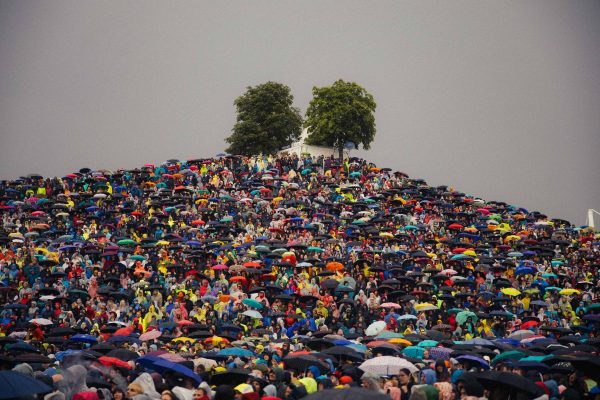
© Das Fest | Steffen Eirich
Weather Preparedness and Resilience Toolbox
Weather and climate define the environmental frame in which festivals take place – and both are changing in ways that directly influence the festival season.
Traditional expectations of “typical summer weather” are no longer reliable. Weeks of stable sunshine can be interrupted by sudden downpours; long dry periods can turn into heavy, concentrated rainfall within hours; and warm evenings may just as easily become nights of unexpected cold or high winds. These shifts do not only create inconvenience – they change the physical environment in which visitors move, rest, queue, camp and celebrate. This is the reason why we have created this Weather Toolbox.
A truly weather-ready festival means thinking of everyone – providing clear, accessible information, planning for comfort and safety, and creating conditions that make every person on site feel protected, included, and welcome, no matter what the sky brings.
The Weather Toolbox brings together practical and research-based resources to give background information on weather & climate to help you design safer and more weather-resilient festivals and outdoor events.
It is aimed at organizers, safety professionals, production teams – everyone involved in planning, building, and operating open-air events. And of course we do not forget about the audience. The PDF version of the Weather Toolbox summarizes the most important topics and includes links to this website, where you can find more detailed texts on everything mentioned in the PDF.
The Toolbox’s Structure
Extreme weather can affect events in many different ways often at the same time. To make it easier to find the right tools and information, this toolbox is divided into practical chapters that address specific aspects of weather preparedness and response.
The first chapter addresses weather & climate in general, whereas the following chapters cover different aspects of planning, risk assessment, communication and implementation on site.
Also, there’s a look into the media and some case studies to show that this is not about theory only but about real life.
Additional resources help to educate yourself and others even better.
We are using ISSUU to host and display interactive PDF files. To access the actual content, click the button below. Please note that doing so will share data with third-party providers.
More Information ‘Glossary

Everyone knows what a “storm” is – but do we really? Do we really speak of the same phenomenom when we say, “there is a storm coming”? – Clear terminology does not only help to improve the understanding of the topic but also is – like clear thresholds – an important part of each risk assessment and each decision matrix.
01 Weather Hazard Awareness
02 Risk Assessment & Planning
03 Monitoring & Early Warning
04 Decision Making & Communication
05 On-Site Implementation
06 Training & Learning
07 Educating The Audience
Case Studies & Best Practices
Further Resources
Mapping the impact of extreme weather on global events and mass gatherings: Trends and adaptive strategies:
https://www.sciencedirect.com/science/article/pii/S2212420925004522?via%3Dihub
Early Warnings for All in Focus: Hazard Monitoring and Forecasting:
https://wmo.int/publication-series/early-warnings-all-focus-hazard-monitoring-and-forecasting
ANSI ES1.7-2021 Event Safety Requirements – Weather Preparedness:
https://webstore.ansi.org/standards/esta/ansies12021
What if it rains? What if there are bushfires?’: extreme weather, climate change and music festivals in Australia:
https://journals.sagepub.com/doi/10.1177/1329878X231184913
Heat and mass gatherings: What is needed?:
https://www.sciencedirect.com/science/article/pii/S3050456224000063
Weather and Climate Risk Communication:
https://extranet.puq.ca/media/produits/documents/3358_9782760547575.pdf
