
About Europe: Christof Huber
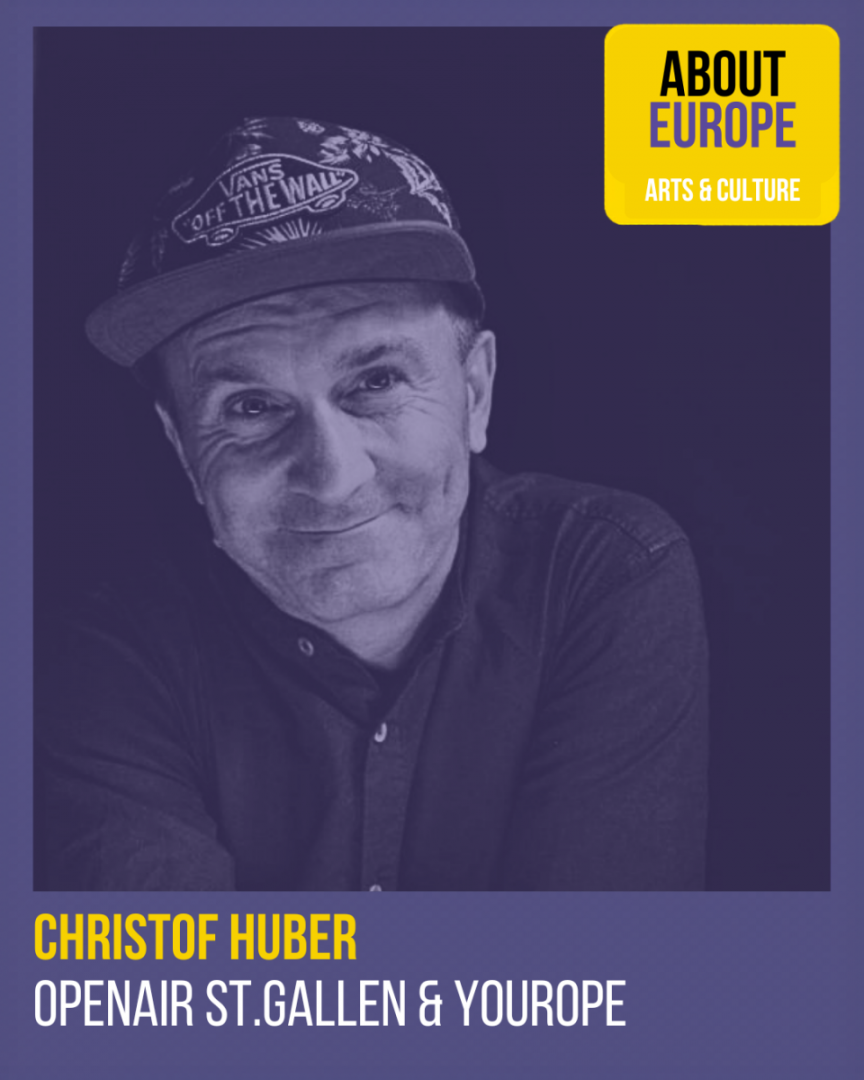
This text by YOUROPE chairman Christof Huber, Director Festivals at gadget Entertainment AG and festival director of OpenAir St.Gallen et al., is part of the project About Europe, in which YOUROPE and our sister network European Festivals Association (EFA) invite the cultural sector to engage in a public conversation about the evolution of Europe – as a continent, as a political entity, as a voice in the world and as a cultural society. Find all YOUROPE contributions to About Europe here.
My Europe
For me, Europe means community. Not a community created by everyone being the same, but one that draws its strength from its diversity. As Chairman of YOUROPE, I work with festival organizers from all over Europe. We come from different countries, cultures and political systems. We’re even competitors. And yet, we’re united by friendship, trust, and the conviction that we can achieve more together than we can alone.
This collaboration has permanently changed my view of Europe and the world. It has shown me that Europe is far more than a political project. Europe thrives through its people, through the exchange of ideas, through solidarity, and through shared values such as openness, freedom, respect, and democracy. As a Swiss citizen, I feel this particularly keenly. Switzerland is not a member of the European Union, and yet I feel like part of this European community. For me, Europe is not a geographical or institutional space, but a human one.
I am convinced that cultural practitioners bear a responsibility for Europe’s development. Not because they must provide political solutions, but because they create spaces where people can come together. Art and culture can foster empathy, broaden perspectives, and foster understanding of other people’s realities. At a time when societies are often drifting apart, this task is more important than ever. Festivals play a special role in this regard. They bring together people from the most diverse backgrounds and create moments in which boundaries lose their meaning. They are small models of an open Europe. That is why festivals should also participate in the European debate. Not to take sides in party politics, but to defend the values on which our coexistence is based. For culture must not allow itself to be overwhelmed by politics. Rather, it must remain an independent space that facilitates discussion, asks critical questions and opens up new perspectives. Our events can be driving forces behind European unity. Often, European ideas are not experienced in capitals or institutions, but in public squares, concert halls, theaters or on festival grounds. That is where the Europe of everyday life takes shape – direct, vibrant and human.
Europe influences my work every day. The exchange within YOUROPE helps us act in a more sustainable, safer, and more responsible way. At the same time, I believe that our festivals can also influence Europe. Everyone who experiences at a festival how diversity, respect, and solidarity can function as a matter of course takes a piece of that experience home with them. For the future, I hope for a Europe that remains curious. A Europe that builds bridges instead of walls. A Europe that sees cultural diversity as its greatest strength and has the courage to stand together, even in difficult times. Because that’s exactly what I’ve learned at YOUROPE: Europe is at its strongest when people listen to one another, learn from one another and work together toward a better future.
Christof Huber
Director Festivals at gadget Entertainment AG
Festival Director of OpenAir St.Gallen et.al.
Chairman of YOUROPE – The European Festival Association


Disclaimer:
Co-funded by the European Union. Views and opinions expressed are however those of the author(s) only and do not necessarily reflect those of the European Union or the European Education and Culture Executive Agency (EACEA). Neither the European Union nor the granting authority can be held responsible for them.