
About Europe: Özgehan Şenyuva
This text by YOUROPE’s special advisor is part of the project About Europe, in which YOUROPE and our sister network European Festivals Association (EFA) invite the cultural sector to engage in a public conversation about the evolution of Europe – as a continent, as a political entity, as a voice in the world and as a cultural society. Find all YOUROPE contributions to About Europe here.
About Europe – A View from the Threshold
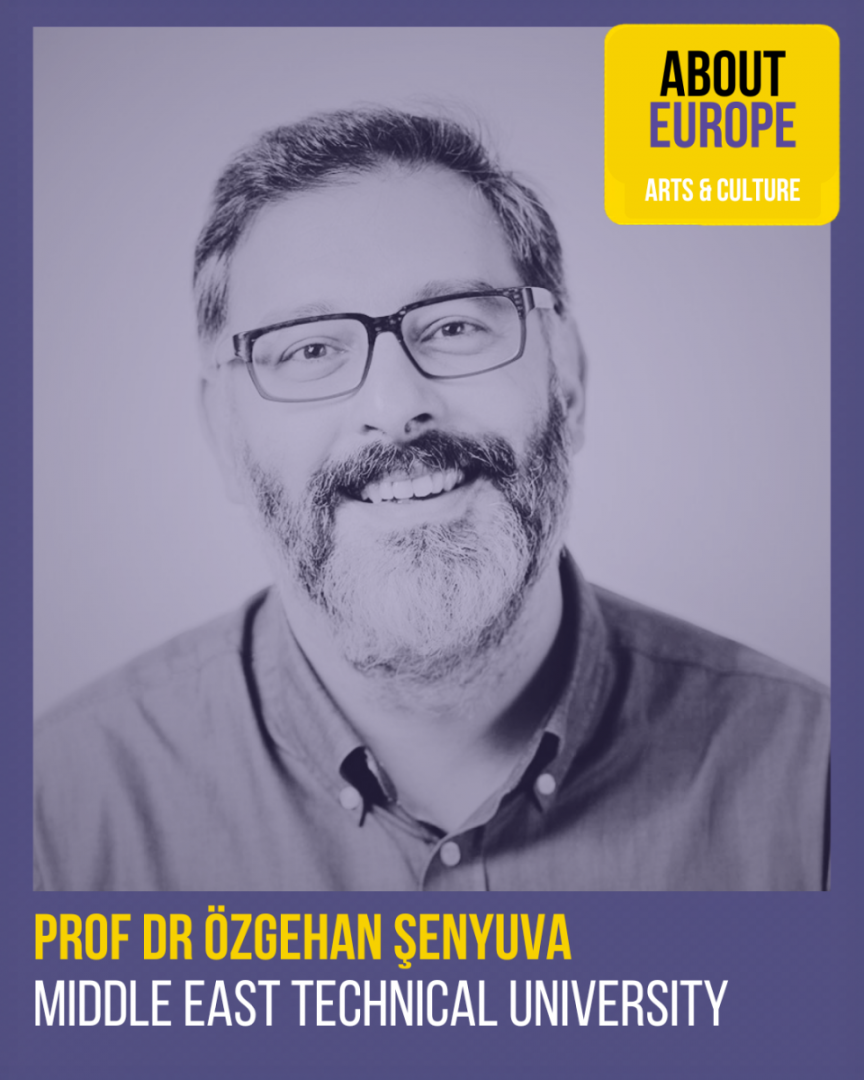
By Prof. Dr. Özgehan Şenyuva, Middle East Technical University, Ankara, & special advisor to YOUROPE
I write to you from Ankara.
That single fact shapes everything I want to say. I am writing about Europe from a place that some would not draw inside its borders – and yet from a city, a country, a region whose history, anxieties and hopes have been entangled with Europe for centuries. I write as a European who is not always recognized as one. And I have come to believe this is the most honest place from which to begin a conversation about Europe: not from its comfortable center, but from its threshold, where the shape of the door is clearest because you are standing in it.
For decades, we were taught to think of Europe as a destination – a place you arrive at once the paperwork is in order. A treaty. A currency. A list of criteria to be met. But Europe was never really a finished address. It is something closer to a promise that has to be kept again every morning, or it stops being true.
What is that promise? Strip away the institutions and what remains is disarmingly simple. The promise that you can be different in public and still be safe. That you can gather with strangers and not be afraid. That the person who does not look like you, pray like you, or vote like you is not your enemy but your neighbor. Europe, at its best, is the wager that openness is a strength rather than a weakness.
This is why I have spent so much of my life in youth work – long before I ever called myself an academic. I began as a volunteer. I became a trainer, then a project coordinator, and eventually vice president of the Youth Express Network (YEN), one of the largest pan-European youth organizations. Only later did I become a scholar: a PhD in Comparative European Politics from Siena, in Italy; then a post-doctoral year in Aberdeen – another corner of the continent now sitting outside the European Union – where I came to see how closely British and Turkish Euroscepticism resemble one another, and how both nations live in a kind of liminality. Never quite inside, never quite outside. Forever negotiating their relationship with a Europe to which they nonetheless belong.
It was through YOUROPE that I eventually found my way to music festivals. And the more time I spent at them, the more clearly I understood what they truly are. Not stages and sound systems, but learning spaces. Civic spaces. Places where people young and not-so-young encounter difference, practice tolerance, and rehearse what it means to live together with strangers. Never mind the spin – the tired caricature, pushed by authoritarians and populists, of festivals as expensive, corrupt, loud, unfit gatherings for a spoiled, rich elite. That image is not a description. It is a strategy. It is meant to make us look away while a civic space is quietly closed.
And so I have come to believe that people in the arts are not bystanders to Europe’s future but among its first defenders. Because a festival is Europe in miniature. For a few days, on a field or in a square, tens of thousands of people who have never met agree to share space, noise, joy and difference. They step outside the “normal” and discover that pluralism is not a threat to be managed but an experience to be lived. That is not entertainment. It is democracy, rehearsed at scale, in real time.
And that is precisely why these spaces are now under pressure across the continent. When democracy weakens, culture is among the first targets – because autocrats and populists understand something we sometimes forget: spontaneous, joyful, uncontrollable gathering is dangerous to anyone who wants a society that is frightened and obedient. People having fun together and talking with each other are more immune to politics of fear. They are not scared of the “other” but curious about it.
The pressure rarely arrives dressed as censorship. It arrives as a withdrawn permit, a “security review,” a question about “public decency,” a quietly cancelled grant. In 2025, a festival born twenty-five years earlier as a student movement against dictatorship – EXIT, in Serbia – began to be under pressure because its founders chose to stand with protesting students. The instrument was bureaucratic. The target was freedom.
I recognize that pattern from where I sit, and I recognize its quieter cousin too: exclusion by price. When a ticket becomes a luxury, cultural participation becomes a privilege, and a generation is slowly, silently shut out of the shared experiences that once taught them they belonged to something larger. A young person in Turkey once told me that the last real festival she could afford to attend was a decade ago. That, too, is a way of narrowing Europe – not with a ban, but with a price tag.
So when this initiative asks whether people in the arts bear responsibility for Europe’s development, my answer is plain: we already do, whether we choose to or not. The only real question is whether we will be intentional about it. When a festival director speaks, journalists listen. When an international network takes a position, governments respond. That reach is not a privilege to guard quietly. It is a responsibility to use – especially on behalf of those who cannot speak without risk: the emerging artist afraid of being labelled, the local organizer fighting permit battles, the volunteer who cannot afford to be seen. We can speak. And if we can, we must.
Is Europe our community? From the threshold, I would put the question differently. Europe is not a club that admits us once we qualify. It is a community we build – or fail to build – by how we treat one another, and above all by how we treat those standing at the edge. Keep the door open. Keep the music playing. Keep the values first, and let everything else follow.
That is what Europe means to me, writing to you from Ankara.


Disclaimer:
Co-funded by the European Union. Views and opinions expressed are however those of the author(s) only and do not necessarily reflect those of the European Union or the European Education and Culture Executive Agency (EACEA). Neither the European Union nor the granting authority can be held responsible for them.